Paceline Politics: Welcoming a Flywheel Bike to the Saturday Bunch
Photo: Chris Talbot, CC BY-SA 2.0, via Wikimedia Commons
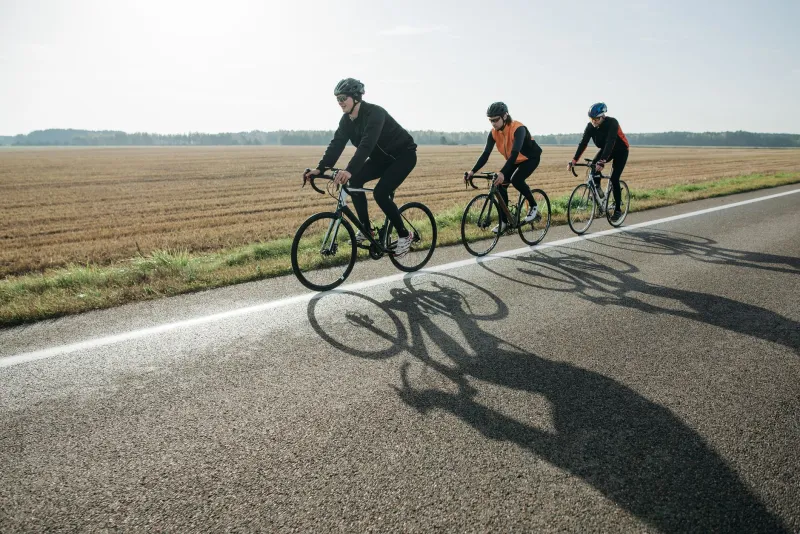
Club runs are peculiar British institutions. They are part sportive, part social club and part mobile committee meeting, usually held on wet tarmac with a cafe stop at the end. So when someone turns up on a gyro-stabilised bike — flywheel humming, battery tucked into the frame — the bunch does what bunches do best: it has opinions.
The question worth asking is not whether a gyro bike belongs on a club run. It is whether stabilisation is a genuine handicap on a fast bunch ride, how non-gyro riders tend to react, and what a ride leader should know before saying “aye, tag on”.
First, what kind of club run are we talking about?
A no-drop winter bunch rolling through Surrey lanes is a different animal from a summer chaingang on flat A-roads, or a hilly reliability ride in the Peak District. The gyro bike’s strengths and weaknesses show up differently in each. On a steady, regroup-at-the-top ride, the extra mass and flywheel drag matter less. On a fast, surge-heavy paceline, they matter a lot.
That distinction gets lost in the pub afterwards. “The gyro bike got dropped” can mean the rider lacked fitness, the route was relentlessly uphill, the group was riding chaingang-style, or the battery cut out at the worst moment. Those are four different stories.
The physics of the paceline
A gyro-stabilised bike carries extra kit: flywheel, housing, control electronics, battery. That mass does not vanish when the road tilts up, and it does not help you match a sudden acceleration out of a junction. In a tight paceline, where half a wheel can feel like a gap and every surge is magnified, a heavier bike is a handicap. There is no polite way around that.
But stabilisation is not propulsion. It does not pedal for the rider, and it does not fake a Strava segment. What it does is help keep the bike upright, particularly at low speed and in gusty conditions. On exposed fen roads or a blustery coastal loop, that can be an asset rather than a liability. The handicap is real, but it is terrain-specific and rider-specific.
Etiquette when the flywheel shows up
The first rule is boring and essential: brief the ride leader before clipping in. Tell them the bike is gyro-stabilised, explain what happens if the system cuts out, and be honest about your pace. A ride leader should not have to discover the flywheel’s behaviour halfway through a busy roundabout.
Start at the back. Not as a punishment — as a courtesy. The bunch needs to learn how the bike behaves, and the gyro rider needs to learn the group’s rhythm. Avoid half-wheeling. Signal early. Leave a little more room for braking, because extra mass takes longer to shed speed. If the group regroups at the top of a climb, say so before the climb rather than after.
Cafe stops are their own negotiation. A flywheel bike attracts questions, and some riders will want to poke the battery like it is a museum exhibit. A short, friendly explanation usually settles it. “It stabilises, it doesn’t motor” is a useful sentence.
What ride leaders should ask
Before welcoming a gyro bike onto a club run, a ride leader should ask four practical questions. What is the battery state? What happens when it runs out — does the bike become a heavy conventional bike, or does it resist steering? What is the rider’s experience in a group? And does the route have enough regroup points for a heavier machine on the climbs?
None of that is about exclusion. It is about the same risk assessment applied to any unfamiliar bike, whether that is a cargo bike, a recumbent or a borrowed winter hack with questionable brakes. British Cycling guidance on group rides emphasises briefing, predictable riding and matching pace to the slowest rider. A gyro bike simply adds one more item to the briefing.
The social politics of looking different
Here is the uncomfortable bit. A gyro bike on a traditional club run can attract suspicion. Some riders will call it cheating, even though it is not providing power. Others will assume the rider is inexperienced, even if they have decades of bunch riding behind them. And a few will spend the whole ride staring at the flywheel instead of the wheel in front.
Banter is part of UK club culture. But there is a line between gentle ribbing and making someone feel unwelcome. If a rider turns up, completes the route and buys the tea, they have done the club run. The bike is a conversation starter, not a membership test.
So is it a handicap?
On a fast chaingang or a hilly reliability ride, yes — the gyro bike is likely to be a handicap. The extra mass and drag cost you on acceleration and climbing, and the bunch will not wait forever. On a steady no-drop club run, especially one with windy exposed sections, the gap narrows. The bike may even help a rider who would otherwise be nervous in crosswinds or at low speed.
The bigger handicap is often social friction. A five-minute briefing and a sensible starting position solve most of it. The rest is just the usual club-run compromise: ride to the slowest rider, regroup at the top, and save the arguments for the cafe.
In 2026, club riding is changing. Gyro bikes are no longer a curiosity in every bike shop window, and adaptive riders are pushing for more inclusive group rides. The Saturday bunch does not have to become a tech demo. It just has to be clear about its pace, its etiquette and its willingness to make room for something different.