Five UK Rides Where Gyro Stabilisation Isn’t Cheating — And Where It Definitely Is

Photo: cyclist commuting winter UK icy road low speed, via i.ytimg.com
If you have been riding for years, the idea of a gyroscopic bike can sound like stabilisers for grown-ups. Fair enough. Most of us learned to balance on a cheap mountain bike and a patch of grass, and we do not need a spinning disc to tell us which way is up. But dismissing gyro stabilisation outright misses the point. It is not there to teach you to ride. It is there to take the edge off specific low-speed situations where even confident riders wobble, overcorrect or put a foot down when they would rather not.
Here are five UK riding scenarios where stabilisation genuinely earns its keep, plus a clear-eyed look at when it is overkill.
1. Icy winter lanes
A cold snap turns a quiet lane into a skating rink. Black ice does not care how many years you have been commuting. A gyro system can help keep the bike upright when the rear wheel steps out at low speed, giving you a fraction more time to react. It does not create grip. It will not save you if you grab a handful of front brake on sheet ice. But it can reduce the panicky correction that turns a small slip into a fall.
Practical advice: run winter tyres with proper tread, lower your pressures slightly, brake earlier and stay off the paint. If your route is a gritted main road, the stabilisation is doing very little. That is when it is overkill.
2. Pothole dodging at crawling pace
UK roads in late autumn are a slalom course of patches, cracks and craters. At 15mph you can hop a pothole without thinking. At walking pace, with traffic behind you and a narrow gap ahead, the bike gets twitchy. A gyro system smooths out the low-speed weave when you are picking a line through broken tarmac.
Practical advice: look two cars ahead, not at the pothole, and keep your weight relaxed. Stabilisation is useful here, but it is not a substitute for suspension or decent tyres. On a smooth towpath or a freshly resurfaced cycle lane, you are paying for tech you will not notice.
3. Filtering through traffic
Filtering is where confident riders earn their stripes. It is also where heavy e-bikes and loaded commuters get awkward. Stop-start traffic means constant low-speed balance, and a gyro system can make those slow, tight gaps feel less nerve-racking. If you carry a laptop, a change of clothes and a week of groceries, the extra stability is noticeable.
Practical advice: filtering is still about observation, not technology. Check mirrors, watch for car doors and do not squeeze gaps that are too narrow. A gyro bike is often heavier, so make sure you are comfortable with its width. If your commute is a wide, fast cycle superhighway, the benefit is marginal.
4. Carrying heavy loads
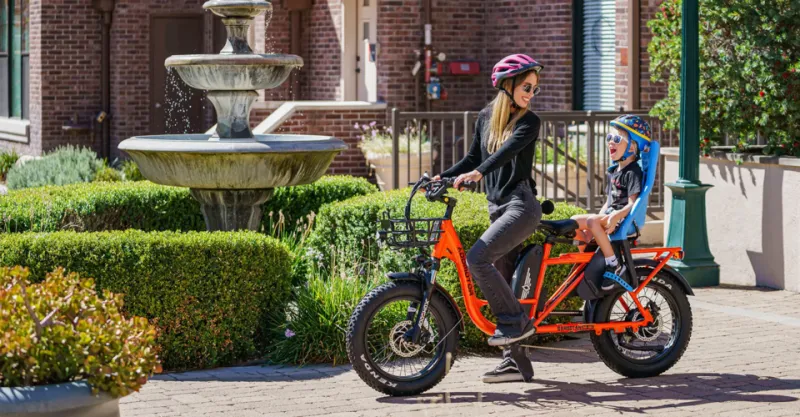
A rear rack loaded with shopping, a front basket full of library books or a child seat with a wriggling passenger changes the handling. Gyro stabilisation helps most at low speed, when the weight wants to tip the bike and your arms are already busy. It is not a substitute for proper load distribution, but it can give you a bit of breathing room at the school gate or the supermarket bike racks.
Practical advice: keep heavy items low and central, check your rack limits and practise loading before you ride. If you are carrying a single rucksack on a short commute, the tech is probably overkill. If you are hauling a week shop up a hill, it starts to make sense.
5. Group rides with mixed abilities
Group rides are brilliant and chaotic. You get fast riders, cautious riders, someone on a heavy hybrid and someone who has not clipped in for months. The pace drops, people stop suddenly, and the pack bunches up. Gyro stabilisation helps less confident riders stay upright when the group slows to a crawl, which keeps the whole ride calmer.
Practical advice: ride predictably, call out stops and leave space. Stabilisation is useful here, but it does not replace bike handling skills. On a fast chaingang or a solo training loop, it is simply extra weight and complexity.
Where it is definitely overkill
If your riding is mostly fast, flat and uninterrupted, gyro stabilisation is not doing much for you. A light road bike on a smooth cycle path does not need help staying upright. Similarly, if you are a confident rider on a simple commuter route, the extra cost and maintenance may never pay back. The tech is at its best when low-speed balance is the problem, not when speed and efficiency are the goal.
So no, gyro bikes are not just for beginners. They are for riders who understand that low-speed control is its own skill, and that sometimes a bit of assistance is not cheating. It is just good sense.